

In this post, I walk you through the exact steps I took—based on my personal experience—to pass the Principles and Practice of Engineering (PE) Exam in Fire Protection on my first attempt.
My goal in sharing this is simply to offer some honest insight and encouragement for others considering the Fire Protection PE Exam—to walk through what worked for me, in the hope it might help someone else feel more prepared or supported, the way I appreciated guidance from others along my own path.
Years ago, I took and passed the Mechanical PE Exam in the HVAC and Refrigeration discipline. But after transitioning into the fire and life safety field—primarily through projects involving smoke control design and performance-based egress analysis—I realized the need to formalize that knowledge. I decided to pursue the Fire Protection PE Exam so I could qualify as the QFPE (Qualified Fire Protection Engineer) on federal projects, which require discipline-specific PE licensure. Some states also mandate a PE in fire protection to serve in that role.
Also, since my undergraduate degree was in mechanical engineering, I found it beneficial to take a structured approach to study all core areas of fire and life safety in depth.
What follows is a step-by-step breakdown of how I studied, what tools I used, and how I managed my time. Use it as a guide to structure your own prep strategy if you find it beneficial.
Watch the video version of this post on YouTube below:
Step 1: Apply & Meet Prerequisites
Before anything else, make sure you’re eligible for the Fire Protection PE Exam under your state’s board requirements. These usually include a combination of accredited education, qualifying engineering experience, and passing the Fundamentals of Engineering (FE) Exam. If you haven’t taken the FE yet, check out my previous post on how I approached that process.
Also, apply as early as possible. At the time of this post, the Fire Protection PE is only offered once per year, and testing locations filled up fast. Applying early helped me secure a test site close to home. Some of my colleagues who delayed had to drive to a further testing site to take the exam—not ideal on an already stressful day.
Step 2: Understand the Exam Format
Spend time reviewing the NCEES Candidate Handbook for the Fire Protection exam. It outlines the number of questions (85), the total exam time (8.5 hours excluding breaks), and the general breakdown of topics. I found it helpful to think of it in terms of time management: roughly six minutes per question. Knowing that early on gave me a mental model for pacing.
I also skimmed through the subject areas to get a sense of the range and depth of material. This informed how I built my study plan—especially how much time to allocate per subject.
Step 3: Choose Your Study Path
This is a major decision. Some engineers self-study using only free or low-cost resources, but I opted for a more structured approach. I personally used MeyerFire University and the Society of Fire Protection Engineers (SFPE) PE Exam Prep Course, and I genuinely believe they were essential to my success.
These courses gave me structured content, weekly targets, and tons of practice problems. Yes, they cost money, but I thought of it as an investment. Failing the PE means you’ll likely need to wait another full year to retake it, which delays any career or salary advancement that comes with being licensed. In that context, the cost of a quality course felt completely justified. Also, some companies are willing to reimburse study material, so make sure to check with your manager before purchasing to see if they can help you with that.
Step 4: Get Two Approved Calculators
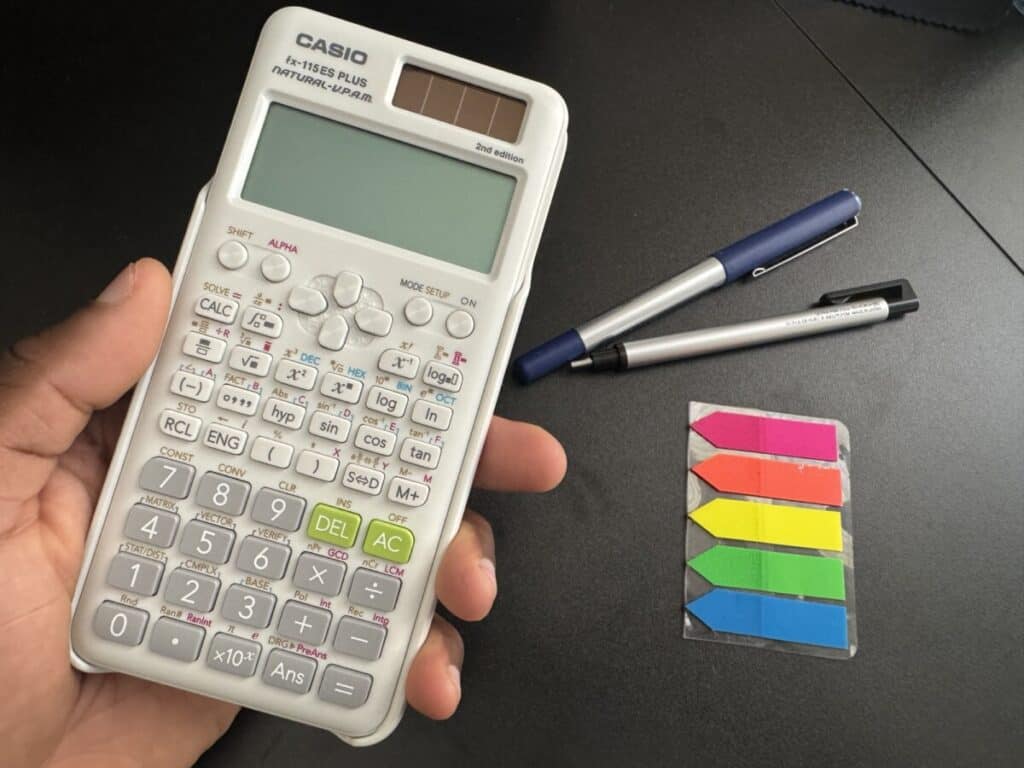
The National Council of Examiners for Engineering and Surveying (NCEES) has strict rules about which calculators are allowed. I bought two identical NCEES-approved models—one for everyday study use and to be used on the exam, and one backup that I kept in the exam-day locker.
This might seem excessive, but I didn’t want my months of preparation derailed by a dead battery or malfunctioning device. Having a backup gave me peace of mind and one less thing to worry about.
I personally recommend the Casio FX–115ES PLUS, the one I am holding in the photo above. Its display functions are simple and pretty smooth. It also allows you to type in equations using fractions and exponents in a form that mimics the way it would look if you were to write it by hand – which makes it easier to verify that your input correctly matches the equations in the reference manual. It is a small detail, but I found it surprisingly beneficial throughout my studies and during the exam.
Step 5: Use the NCEES Reference Manual Every Study Session
The NCEES PE Fire Protection Reference Handbook is the only reference you can use during the exam, so I made it my constant study companion. I used it during every practice session to build familiarity.
Eventually, I read the manual cover-to-cover multiple times. This wasn’t just rote reading—I wanted to build a mental map of where things were. Over time, I developed a sense of where certain equations or charts lived, like, “this table is usually after that big chart,” or “this equation shows up early in this section.” That saved me a lot of time during the actual test.
Step 6: Treat Lectures as Entry Points, then Prioritize Self-Study and Practice
Lectures from prep courses are an essential kickoff point—but not the destination. I found that watching them once was usually enough to get the big picture. From there, deeper understanding came from reading and doing.
I stuck to a 50/50 study model: half of my time went into background reading, and the other half into practice problems. That balance helped solidify my conceptual understanding while sharpening test-day skills. Below is how I broke down that 50% background reading:
Background Reading Breakdown
- Read the NCEES Reference Manual like a book
I read it cover-to-cover multiple times. This helped me develop an intuitive sense for where formulas and tables were located. Even remembering things like “this equation is before that big chart” saved time during the test. - Follow course-assigned readings
Both MeyerFire and SFPE recommend specific chapters from the SFPE Handbook, NFPA Handbook, NFPA codes, and other texts. I followed those to the letter and treated them as essential. - Skim each referenced code or standard
I didn’t read every word, but I made sure I was familiar with the structure, common sections, and main content of each standard. That helped me locate information faster when it came up in questions.
Here’s a list of the NFPA standards referenced in the exam that I reviewed in advance:
- NFPA 11– Low-, Medium-, and High-Expansion Foam
- NFPA 12– Carbon Dioxide Extinguishing Systems
- NFPA 13– Installation of Sprinkler Systems
- NFPA 20– Stationary Pumps for Fire Protection
- NFPA 25– Inspection, Testing & Maintenance of Water-Based Systems
- NFPA 30– Flammable and Combustible Liquids Code
- NFPA 72– National Fire Alarm and Signaling Code
- NFPA 92– Smoke Control
- NFPA 101– Life Safety Code
- NFPA 400– Hazardous Materials Code
- NFPA 2001– Clean Agent Fire Extinguishing Systems
Exam Topic Breakdown
The NCEES Fire Protection PE Exam consists of 85 questions divided among four main topic areas. Here’s the topic breakdown at the time of writing this post including percentage ranges, based on the number of questions out of 85. For the most recent breakdown refer to the NCEES Exam Specifications document on their website:
| Topic Area | Number of Questions of 85 | Percentage Range |
|---|---|---|
| Fire Protection Analysis | 17–26 | 20%–31% |
| Fire Dynamics Fundamentals | 11–17 | 13%–20% |
| Active and Passive Systems | 31–47 | 36%–55% |
| Egress and Occupant Movement | 11–17 | 13%–20% |
This distribution makes it clear that Active and Passive Systems dominate the exam, potentially comprising over half the questions. Still, each of the other sections could have a significant number of questions, so it’s important not to ignore any of them.
I used this structure to guide how I allocated study time. More weight went to the largest sections, but I made sure to spend at least some time in every category to avoid surprises on exam day.
In summary, treat lectures like a primer. From there, lean hard into reading the NCEES reference manual, reviewing assigned texts, and getting familiar with the listed NFPA codes and standards. That foundation will support all the practice problems that follow.
If you’re using a review course, it’s tempting to rewatch lectures multiple times. I learned that once was usually enough. I treated the lectures as overviews, then moved into deeper self-study through readings and practice.
Step 7: Study All Exam Topics, Even Weak Areas
This exam covers a wide range of fire protection topics. In my opinion, unlike the Mechanical HVAC PE Exam, which I previously took and passed, you can’t just master a few core subjects and skate by. For HVAC, I felt like if you had a strong grasp on 5 or 6 main areas, you could perform well.
But with the Fire Protection PE, I found that you really need to be proficient across the board. One SFPE instructor put it well: “It’s hard to hide a weakness on this exam.” That quote stuck with me. I made it a point to work on even the topics I may have felt were obscure or did not have that many questions. Often, the questions are relatively surface-level, so just reaching a basic comfort level can be enough to get those points.
Step 8: Stick to a Long-Term and Consistent Schedule
I studied over about 8 months, logging somewhere around 300 hours total. I averaged 8–12 hours per week and used pomodoro sessions (25-minutes study, 5-minute break, repeat…) to maximize retention.
Having a set schedule helped me stay consistent without burning out. I treated those study blocks like appointments: protected time, no distractions. Giving concepts time to settle and connect over weeks and months helped me retain far more than cramming would have.
Step 9: Adopt a “Career-Applicability” Mindset When Studying
This was probably the most motivating part of my prep. I didn’t study just to pass; I studied because I knew I’d be using this knowledge in real-world projects. That mindset made the process more meaningful.
Instead of memorizing formulas and rules, I tried to understand them—why they mattered, when they applied, and what assumptions they relied on. This deeper learning approach made studying less of a chore and more like professional development I actually cared about.
Step 10: Switch to Practice-Focus 6–8 Weeks Out
In the final month or two before the exam, I transitioned to nearly all practice problems. MeyerFire had these great one-hour mini-exams with 10 questions each. I treated them like simulations: timed, quiet room, only the reference manual allowed.
The most important practice exam is the official NCEES Fire Protection PE Practice Exam that is for sale on their website.
This phase was about sharpening speed, identifying any final gaps, and building mental endurance. I started timing everything, reviewing my pacing, and dialing in how quickly I could look things up in the manual.
Step 11: Prepare Physically in the Final Days
The few days leading up to the exam are not the time to cram. At that point, I focused on getting solid sleep, staying hydrated, and eating balanced meals. That may sound basic, but mental sharpness relies heavily on physical wellness.
I stopped heavy studying two nights before the exam and did only light review the day before. I made sure to go to bed early and avoid anything that might disrupt my rest. You’ll be sitting in a chair and staring at a computer screen for nearly nine hours—your body and mind need to be in good shape for that endurance challenge.
Step 12: Set Yourself Up for Exam Day
On the morning of the test, I wore comfortable clothes and arrived at the test center at least 30 minutes early. Being early helped reduce stress and gave me time to settle in. I made sure to eat a solid breakfast and hydrate without overdoing it—remember, there’s only one scheduled break. I am also not a big coffee drinker, but I drank 2 shots of espresso right before starting the morning session, and another 2 right before starting the afternoon session, and it helped me with alertness and concentration.
Many people I spoke with after the exam described it as physically and mentally exhausting. They’re not exaggerating. This isn’t just about knowledge; it’s about sustaining concentration over an extended period. Preparing for that reality helped me avoid surprises.
Step 13: Use the 3-Pass Strategy During the Exam
I honestly believe this strategy is one of the biggest reasons I passed. Throughout college and high school, I struggled with running out of time on exams. I often knew the material but couldn’t finish in time. The 3-Pass Strategy changed that.
This method helps you prioritize your time and reduce stress. On the first pass, you answer the questions you know immediately. On the second, you return to moderately difficult ones. On the third, you give your best effort to the hardest questions. This approach kept me calm and efficient.
For computer-based tests like the PE, this is especially helpful because navigating back and forth is easy. It let me maximize my score without getting bogged down early on. I wrote more about this method in my post on exam strategies—check it out for a full breakdown.
Step 14: Wait for Exam Results
At the time of writing this post, an unofficial trend I noticed (and many others confirmed) is that NCEES typically releases exam results on the Wednesday morning of the week after the exam. I found myself refreshing my NCEES portal page that morning and it came around 10am Eastern Time. It’s nerve-wracking, but knowing when to expect results helped me mentally prepare.
Step 15: Celebrate and Look Forward
Once the results are in and the exam is finally behind you, take a moment to recognize the people who supported you along the way. Many families adjust schedules, carry extra responsibilities, or simply provide the encouragement that keeps you moving forward during the long study months. Thank them—your success is part of their effort too.
With the exam complete, you can look ahead with a renewed sense of freedom. In some states, such as Maryland, you become a licensed Professional Engineer almost immediately upon passing, with your license number issued shortly after results are released. Other states and countries may require additional documentation or administrative steps, but these are usually procedural. The hardest part—the exam—is now firmly behind you.
This is also an appropriate time to evaluate your professional trajectory. Passing the PE exam often opens doors that were previously out of reach. Begin discussing compensation, responsibility, and promotion opportunities with your employer. You may also find that roles requiring a PE—roles you once viewed as long-term goals—are now well within reach.
As you transition into practice, revisit the roles, responsibilities, and ethical obligations of a Professional Engineer. Organizations such as SFPE provide valuable guidance on professional conduct, and your state board will outline licensure maintenance, renewal requirements, and continuing education expectations. Staying aligned with these principles helps ensure your work reflects the integrity associated with the PE designation.
Above all, remain humble. Passing the exam signifies proficiency, not mastery. New PEs often feel pressure to present themselves as experts, but seasoned engineers will tell you the same thing: no one has all the answers. Growth in this profession comes from asking thoughtful questions, acknowledging uncertainty, and continually seeking out new knowledge. The license is not the end of the journey—it’s the beginning of a more informed, more responsible phase of your career.
Summary Checklist
- ✔️ Applied early and confirmed eligibility
- ✔️ Mapped out the exam format
- ✔️ Used paid courses for structure and content
- ✔️ Got two NCEES-approved calculators
- ✔️ Studied with the NCEES manual every session
- ✔️ Balanced lectures, readings, and problem-solving
- ✔️ Worked on all topic areas, not just strengths
- ✔️ Spread 250–350 study hours over 6–9 months
- ✔️ Stayed motivated by connecting study to real work
- ✔️ Focused on timed practice in final weeks
- ✔️ Prioritized sleep, hydration, and rest before the exam
- ✔️ Arrived early, dressed comfortably, and managed stamina
- ✔️ Used the 3-Pass Strategy to maximize time and reduce stress
- ✔️ Watched for results the week after the exam
- ✔️ Celebrated with loved ones and looked forward in my career
I hope this breakdown encourages anyone feeling hesitant about taking the Fire Protection PE Exam. It’s a challenging journey, no doubt, but it’s completely doable and absolutely worth it.
Recent Posts
Step-by-Step Guide: How I Passed the PE Exam in Mechanical HVAC and Refrigeration
In this post, I walk you through the exact steps I took to pass the Principles and Practice of Engineering (PE) Exam in Mechanical (HVAC and Refrigeration) on my first attempt. My goal is to offer...
Problem: Many mechanical HVAC design engineers find themselves responsible for smoke control systems—yet often feel a vague cloud of uncertainty around how to design them confidently. This...